
Skip to content

Cart

Your cart is empty

Article: Perfume Glossary: Fragrance Terms Explained

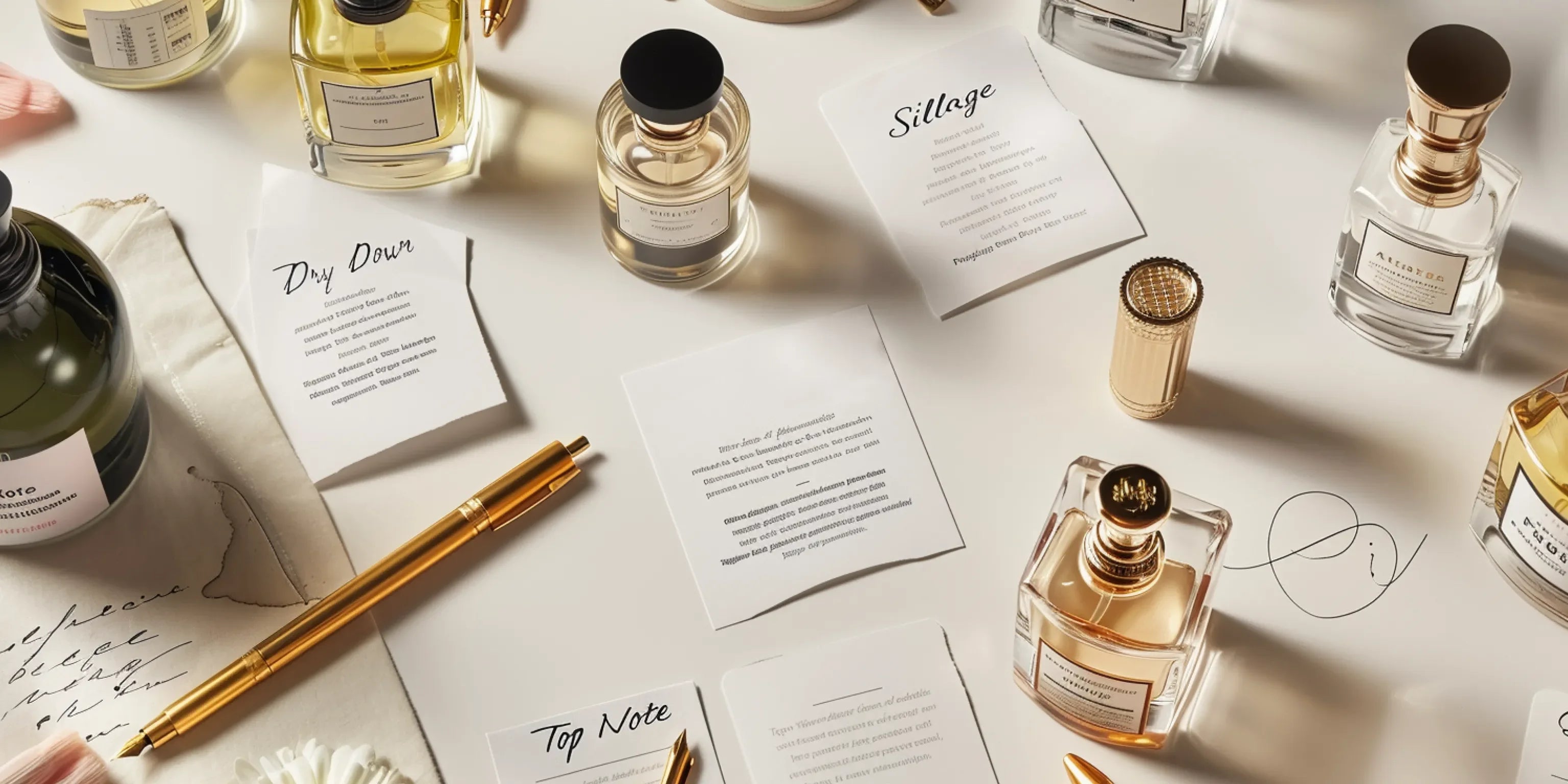
Parfüm-Lexikon mit Begriffen wie Sillage, Projektion und Dry Down

Perfume Glossary: Fragrance Terms Explained

Fragrance knowledge

Perfume terms explained clearly

What is the difference between sillage and projection? What happens during the dry down, and does Eau de Parfum automatically last longer? This perfume glossary explains essential fragrance terms clearly and without unnecessary jargon.

Looking for a particular ingredient or note such as amber, rose, or vanilla? Visit our A–Z fragrance note encyclopedia.

A

Accord

An accord is created when several fragrance materials combine to produce a distinct new impression. A leather, amber, or marine accord does not necessarily come from one raw material. Like notes in music, individual components work together to form a recognisable whole.

Back to top ↑

B

Base note

Base notes form the foundation of a perfume. They often become more noticeable as the brighter opening softens and help shape the later stages of the fragrance. Vanilla, musk, woods, patchouli, resins, and oud are common examples.

Top, heart, and base notes do not unfold as three completely separate chapters. They overlap and develop together. Our guide to reading a fragrance pyramid explains the structure in more detail.

Blind buy

A blind buy is a perfume purchased without first testing it on your own skin. Notes, fragrance family, and a detailed description can make the choice more informed, but they cannot fully replace personal experience.

If you are sensitive to particular scent profiles or still unsure, a sample or smaller size is usually the safer place to start.

Balsamic

Balsamic notes feel soft, warm and gently resinous. They often recall vanilla, benzoin or other resins and give a fragrance extra depth.

Back to top ↑

C

Chypre

Chypre describes a fragrance family built around a fresh citrus opening and a warm, earthy-woody base. Bergamot, floral nuances, patchouli and mossy or resinous accents often meet in this style.

Back to top ↑

D

Dry down

The dry down is the later stage of a perfume after the more volatile opening has softened. Warm woods, musk, vanilla, amber, resins, and other longer-lasting materials often become clearer during this phase.

The dry down is not identical on every person. Skin, temperature, the amount applied, and the complete formula all influence how it smells.

Back to top ↑

E

Eau de Cologne (EdC)

Eau de Cologne is usually light, fresh, and citrus-led. A common guideline is approximately 3–8% fragrance concentrate, often around 5%. The name describes a concentration style, not the quality of the perfume.

Eau de Parfum (EdP)

Eau de Parfum commonly contains around 10–20% fragrance concentrate, often about 15%. It frequently feels fuller and may remain noticeable longer than a lighter concentration, but the label alone cannot guarantee a specific wear time.

Our EdP and EdT comparison explains why two concentrations may also differ in character.

Eau de Toilette (EdT)

Eau de Toilette commonly contains around 5–15% fragrance concentrate, often about 10%. Many EdTs feel brighter, livelier, or more transparent. That does not make them inferior: some compositions show their freshest and most vibrant side in this form.

Extrait de Parfum

Extrait de Parfum is one of the more concentrated fragrance forms. A common guideline is around 15–40% fragrance concentrate, often about 20%. An extrait can feel dense and long-lasting without necessarily projecting more loudly than an Eau de Parfum.

Back to top ↑

F

Fragrance concentration

Fragrance concentration describes the approximate proportion of fragrance concentrate in the finished composition. Terms such as Eau de Toilette, Eau de Parfum, and Extrait de Parfum provide a useful guide.

There are no universally binding percentage limits that every brand must follow. Concentration alone also determines neither quality nor longevity; the formula and the materials used matter just as much.

Fragrance family

A fragrance family describes the overall character of a perfume, such as floral, woody, fresh, gourmand, aromatic, or oriental. It helps place many individual notes within a broader scent profile.

A perfume can combine characteristics from several families, so descriptions such as “floral woody” or “fresh aromatic” are completely normal. Explore our fragrance families and scent styles for a practical overview.

Fragrance pyramid

The fragrance pyramid organises a composition into top, heart, and base notes. It indicates which notes shape the opening, which define the character, and which may become more prominent later.

It is a useful guide rather than a minute-by-minute timetable. Our detailed fragrance pyramid guide shows how to compare two perfumes with it.

Fougère

Fougère is an aromatic fragrance family with a green, lightly woody character. Lavender, herbs, woods and often tonka bean come together in a clear, polished style.

Back to top ↑

G

Gourmand

Gourmand fragrances recall sweet or creamy treats such as vanilla, caramel, chocolate, honey or tonka bean. They can feel cosy, warm, sensual or surprisingly light.

Back to top ↑

H

Heart note

Heart notes become clearer as the initial opening begins to soften. They form the centre of the composition and often define its recognisable character. Florals, fruits, spices, and aromatic notes frequently appear here.

When shopping online, it is usually more helpful to consider the heart and base than to judge a perfume by its top notes alone.

Back to top ↑

L

Layering

Layering means deliberately combining two or more fragrances. It can make a composition feel warmer, fresher, creamier, or more personal. A simple starting point is to pair a quiet base such as musk or vanilla with a lighter floral or citrus scent.

Begin sparingly with two products and test the result on skin. Find more ideas in our perfume layering guide.

Longevity

Longevity describes how long a perfume remains noticeable on skin or clothing. It depends on the formula, the materials used, dosage, skin condition, temperature, and other wearing conditions.

A fixed number of hours can therefore only be a rough indication. Fragrance often clings to fabric for longer, but it develops differently there than it does on skin.

Back to top ↑

M

Musk

Musk feels soft, clean and close to the skin. In modern fragrances it gives floral, powdery or woody compositions a smooth, creamy depth and supports a polished dry down.

Back to top ↑

O

Oud

Oud is an intensely aromatic woody-resinous note with warm, balsamic and often gently smoky facets. Depending on the blend, it can feel dark, soft, spicy or surprisingly elegant.

Back to top ↑

P

Projection

Projection describes how far a fragrance radiates from the body into the surrounding space. It is often strongest soon after application and may become considerably quieter as the perfume develops.

Strong projection does not automatically mean long wear. A fragrance may radiate widely at first and soon become skin-close, while another stays subtle near the body for many hours.

Patchouli

Patchouli smells earthy, woody and lightly spicy. In small amounts it adds depth to floral or sweet fragrances; with woods and amber it feels warm and refined.

Back to top ↑

S

Sillage

Sillage is the scent trail a perfume leaves in the air as you move. The French word is also used for the wake behind a ship, which is a helpful image for the fragrance trail that follows a person.

Sillage and projection are related but not identical. Projection describes how far the scent radiates from the body; sillage is the trail created in motion.

Signature scent

A signature scent is a perfume you wear often enough for other people to associate it with you. It does not need to be rare or especially powerful. What matters is that you enjoy wearing it and that it fits naturally into your life.

It is often easier to find one by comparing the notes and fragrance families you repeatedly enjoy rather than focusing on a particular name.

Back to top ↑

T

Top note

Top notes create the first impression immediately after application. Citrus fruits, light herbs, green accords, and fresh spices are especially common in the opening.

Because many top notes are relatively volatile, a perfume should not be judged on its first few minutes alone. The heart and base reveal where the fragrance is truly heading.

Back to top ↑

U

Unisex

Unisex fragrances are designed to appeal to women and men alike. The label matters less than the notes and the way the fragrance feels on you.

Back to top ↑

Z

Citrus notes

Citrus notes bring freshness and lightness to a fragrance. Bergamot, lemon, lime, orange or grapefruit often shape the opening and give a composition a lively lift.

Back to top ↑

Frequently asked questions about perfume terms

What is the difference between sillage and projection?

Projection describes how far a perfume radiates from the body. Sillage is the trail left in the air as someone walks or moves. A perfume may project noticeably yet leave a short trail, or remain softly present in the surrounding air for longer.

Does Eau de Parfum always last longer than Eau de Toilette?

Eau de Parfum often remains noticeable for longer, but this is not guaranteed. The fragrance materials and complete formula can matter more than the concentration name printed on the bottle.

Is a fragrance note the same as an accord?

No. A note is an individual perceptible component or named facet. An accord is created by several materials that combine to produce a new impression, such as leather, amber, or sea air.

Why does a perfume smell different later than it does when first sprayed?

The materials in a composition evaporate at different rates. Lighter notes often shape the opening, while other facets become clearer later. Skin, temperature, and surroundings also influence the development.

You may also be interested in

More articles

Haut- und Haarpflege mit Rizinusöl - Oriental-Style

Castor Oil Guide: How to Use for Skin, Hair & Brows

Castor oil is a versatile natural product for hair, lashes, brows and skin. Learn how to use it correctly for cleansing, moisturizing and healthy growth.

Read more
Parfüm-Layering: Zwei Düfte Schritt für Schritt kombinieren

Perfume Layering: How to Combine Fragrances

Two fragrances, one new effect: learn how perfume layering works, which combinations make a good starting point and how to create your own balanced pairing step by step.

Read more